Enrichment analysis
The MGG Cytoscape App of ours enables enrichment/depletion analysis of the microbetag annotated network
at the nodes level.
This means that you can test whether the nodes (taxa) of a cluster are enriched with phenotypic traits assigned to them based on
genomic-based predictions using phenotrex,
and or FAPROTAX.
In this tutorial, we use the microbetag-annotated network derived from the example case for running microbetag with big datasets that makes use of the Qiita publically available dataset from the HMP.
But first, let’s have some basics on enrichment analysis.
Background and MGG implementation
The goal of enrichment analysis is to determine whether specific traits are overrepresented in an experimentally derived set/list; for example, whether specific biological functions or processes are overrepresented in an experimentally derived gene list, as described in a tutorial by Juan R Gonzalez in RPubs. Likewise, a trait may be depleted in a cluster, compared to the others.
To perform such an enrichment/depletion analysis, MGG implements enrichment in two steps.
First, we search for traits found differentially present among clusters.
Second, we assess whether these traits are overrepresented in the cluster, exceeding the proportion expected by chance.
A straightforward way to assess this hypothesis consists of applying a hypergeometric test, which in fact corresponds to the one-tailed
Fisher’s exact test.
As described in the Gonzalez tutorial, a hypergeometric test assesses whether a number of successes in a sequence of draws follows a hypergeometric distribution. The hypergeometric distribution is a discrete probability distribution that describes the number of successes in a sequence of draws from a finite population without replacement, just as the binomial distribution describes the number of successes for draws with replacement.
Adjusted in the microbetag framework, this involves the following quantities:
enriched traits |
non-enriched traits |
total |
|
|---|---|---|---|
Within cluster |
\(k\) |
\(m-k\) |
\(m\) |
Outside cluster |
\(n-k\) |
\(N+k-n-m\) |
\(N-m\) |
total nodes |
\(n\) |
\(N-m\) |
\(N\) |
where:
\(N\): is the total number of taxa (nodes) considered
\(n\): is the number of taxa found with the trait.
\(m\): is the number of taxa in the cluster.
\(k\): is the number of taxa with the trait in the cluster.
Based on these counts, MGG makes use of the
HypergeometricDistribution
class to get the probability distribution and the corresponding p-values:
HypergeometricDistribution distribution = new HypergeometricDistribution(totalNodes, totalNodesWithPropertyX, totalNodesInCluster);

double pValForEnrichment = 1 - distribution.cumulativeProbability(nodesWithPropertyXInCluster - 1);
and, supports two approaches for calculating the False Discovery Rate:
Bonferroni: more conservative, reducing false positives but increases false negatives ( \(\frac {\alpha} {m}\), where \(\alpha\) is the required significance level, and \(m\) the number of total tests. Example: if you perform 100 tests, and you have a threshold of 0.05, then only tests with a p-value \(\leq 0.05/100 = 0.0005\) will be considered significant.
Benjamini - Hochberg: less conservative, best for explorative analyses. It ranks the p-values and then adjusts the p-value by applying: \( p_{adj} = p_i * \frac{m}{rank(i)} \). Thus, it may allow some false positives, but allows more discoveries while controlling the expected proportion of false positives.
How-to
After performing microbetag having enabled the network clustering step (using manta), we ended up with a network that
besides the FAPROTAX and phenDB-like annotations, it also splits its nodes to 2 big clusters.
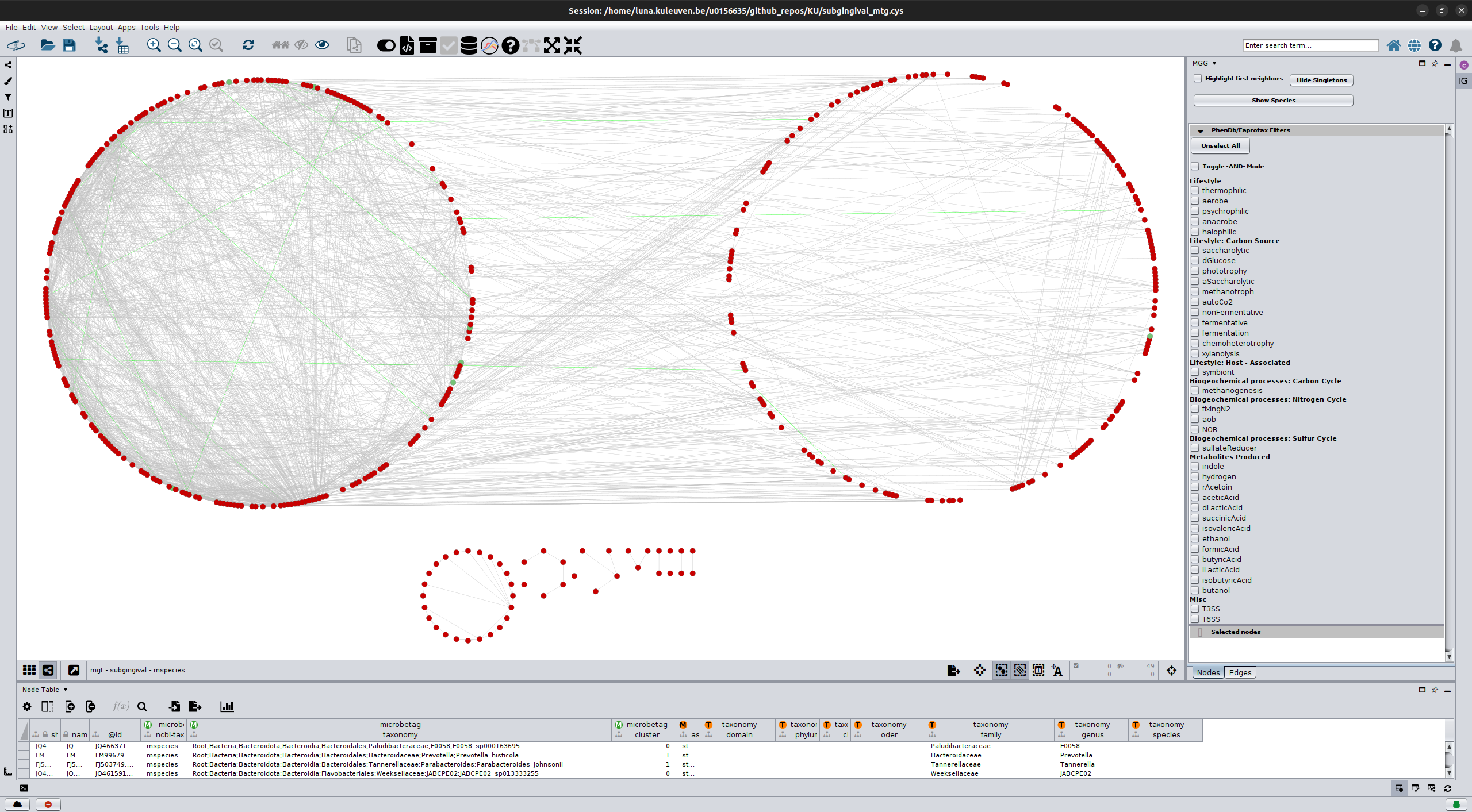
In the figure above, all nodes on the left “circle” have been assigned to cluster 0 while all those on the right “circle and those
below them, have been assigned to cluster 1.
Through MGG we may check/uncheck one or more of their annotations. For example, by clicking on the symbiont box, one can see which nodes have been annotated with this term across the network:

However, we need statistics to check whether a cluster has more nodes (taxa) annotated with a trait compared to the other ones.
In the Nodes table of Cytoscape, you can find its corresponding column, called manta::cluster.
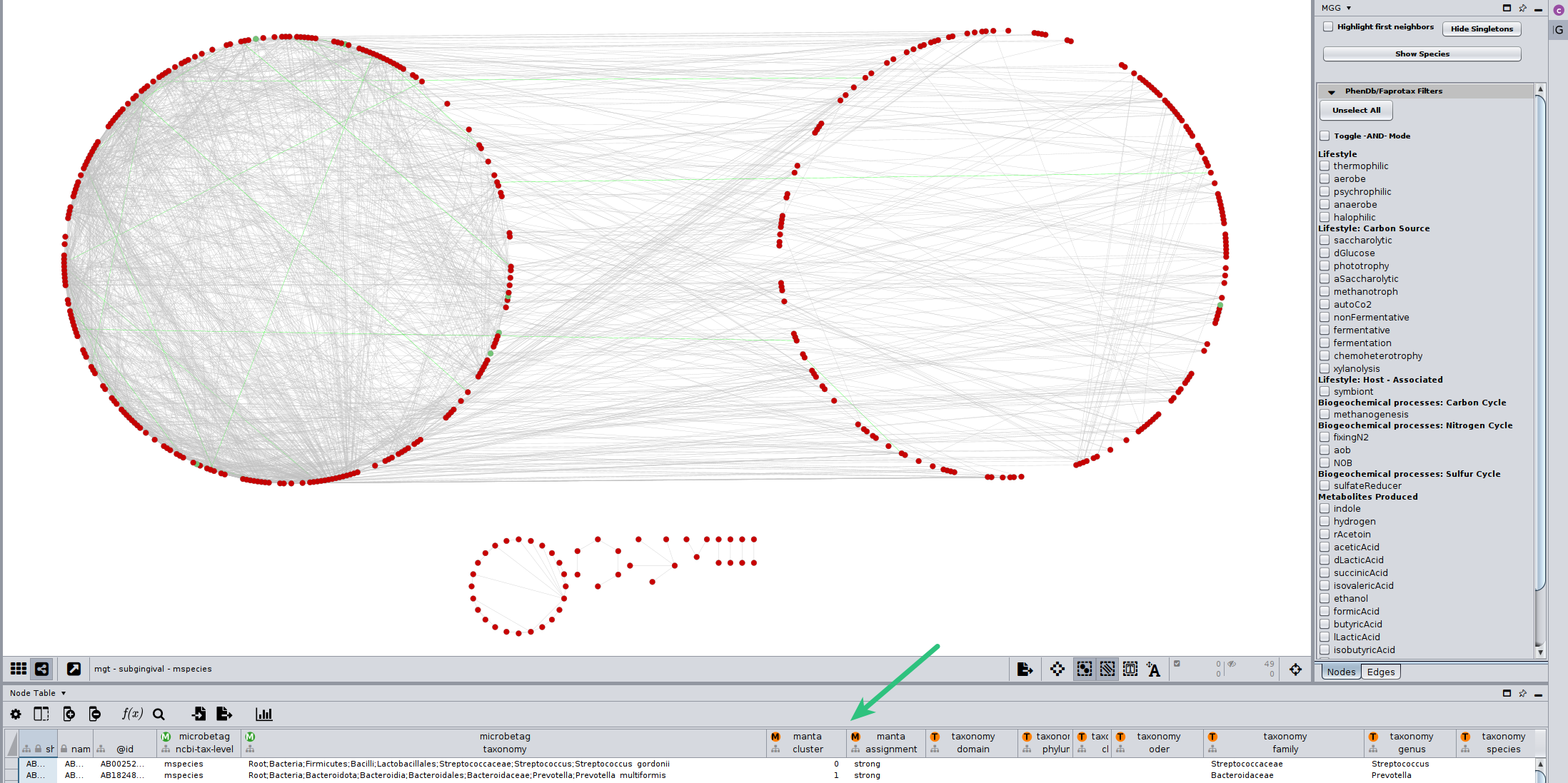
Note
manta uses a diffusion-based proccess
to carry out network clustering, and you may find
more on how it works and its findings at this
demo case.
However, there is a great range of network clustering algorithms you could go for.
In all cases, once you cluster your network, each node will be assigned to a cluster.
Several clustering results can be applied to the same network.
Apparently though, only one at a time can be used for the enrichment/depletion test.
To proceed to the MGG enrichment/depletion analysis,
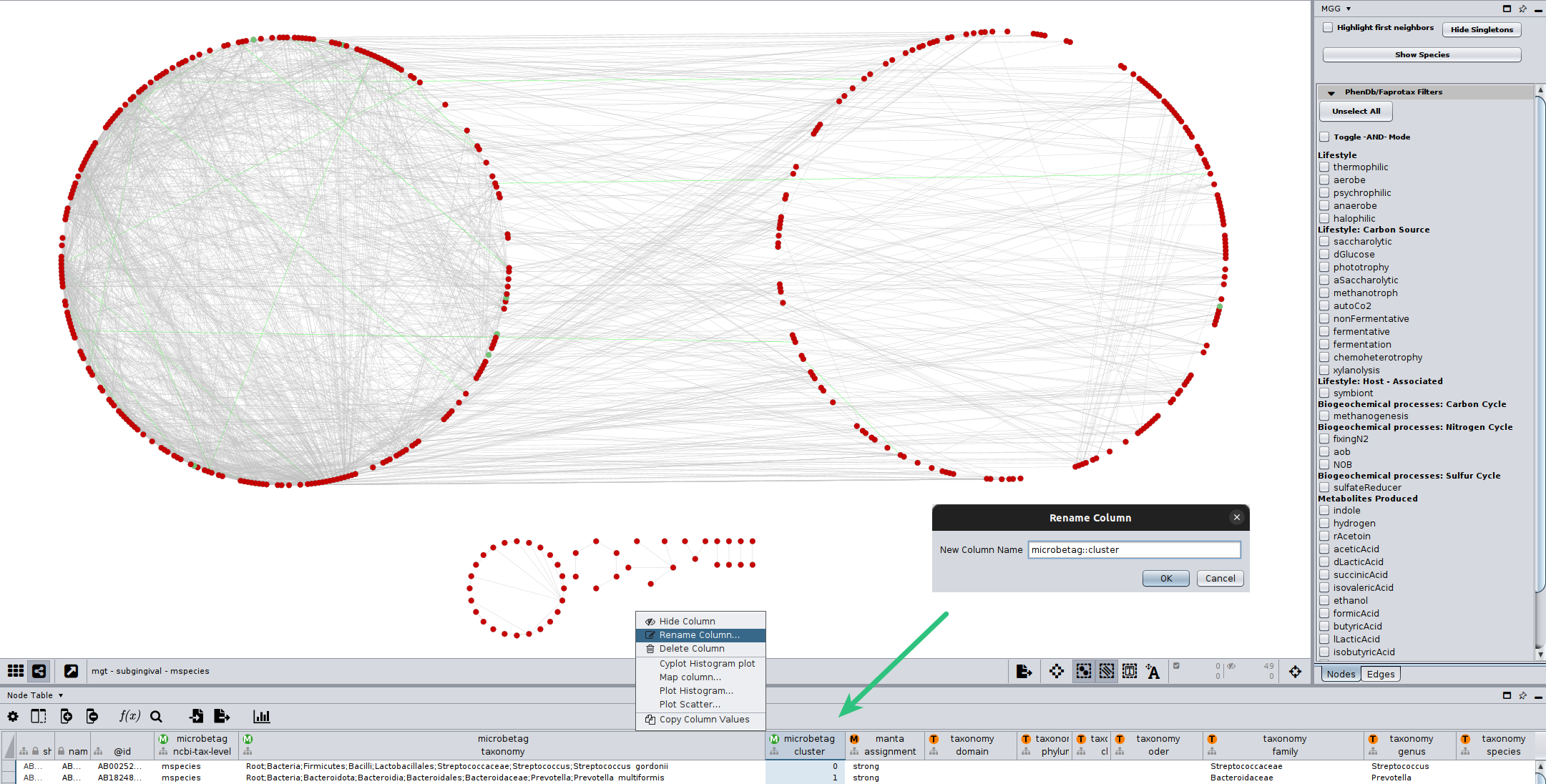
you need to rename your cluster-assigned column, so it is under the microbetag namespace.
For example, assuming you wish to use the manta clusters as returned from running microbetag,
you would rename the manta::cluster column (as shown in the figure above), to microbetag::cluster.
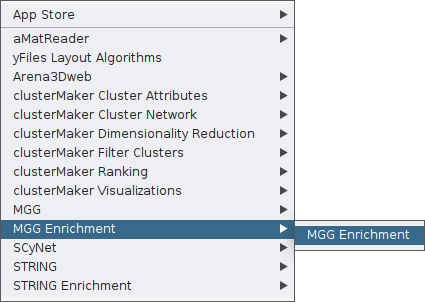
Now, by clicking again on the Apps tab, you may use the MGG Enrichment feature.
You can also set which FDR method to use and its corresponding p-value threshold.
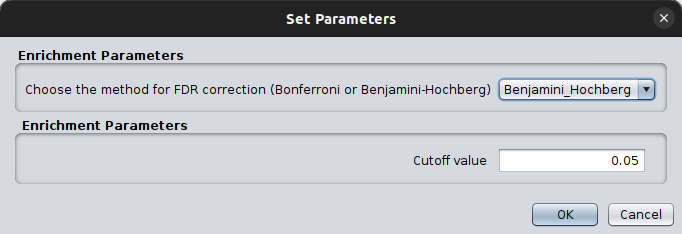
After setting which static to use, you can fire the enrichment/depletion test by clicking Ok. This will return a pop-up table

Notably, microbetag was able to find statistically significant changes between the two clusters, with cluster 1 being enriched with several terms,
among them acetic acid and D-lactic acid, meaning cluster 1 was enriched in taxa producing those compounds.
So, let’s have a look now on how the taxa producing lactic acid distribute between the two clusters:
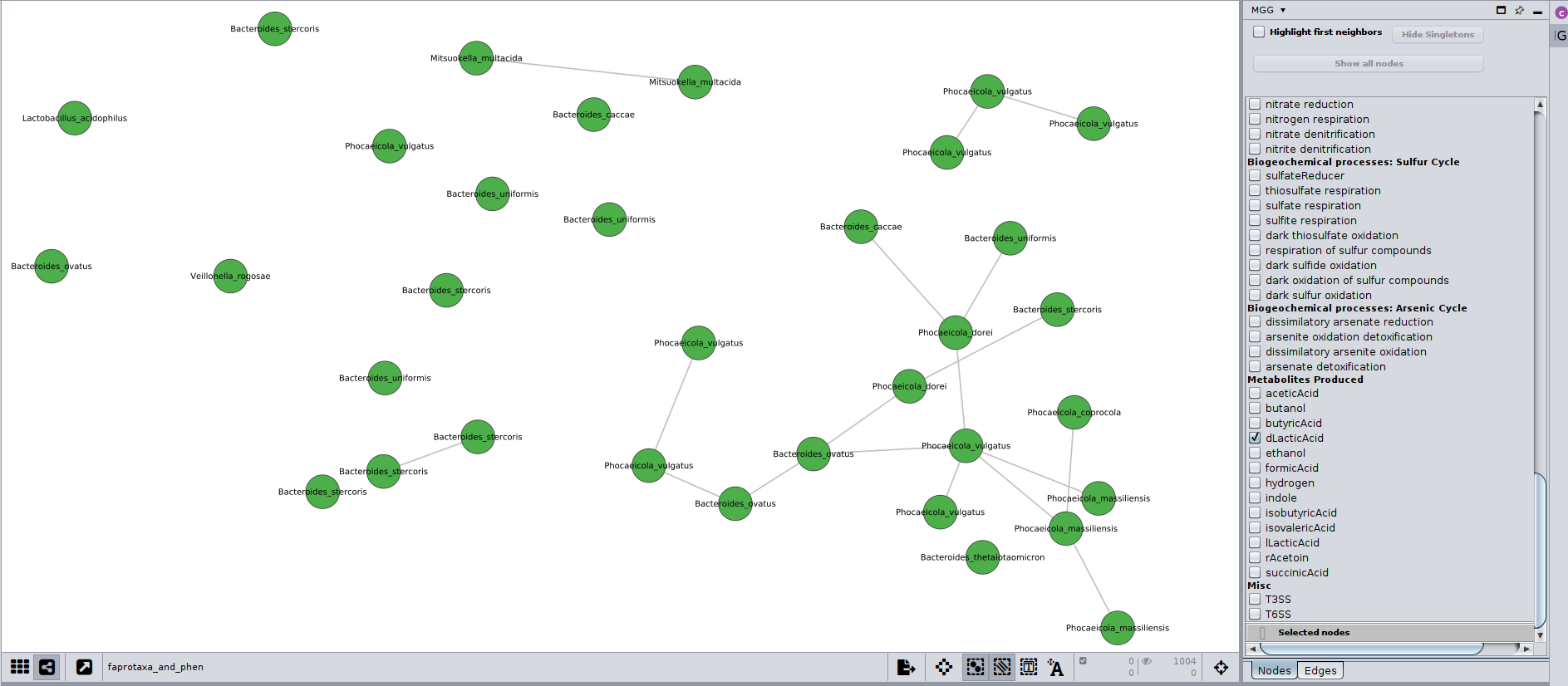
It seems that only taxa from cluster 1 are lactic acid producers (not shown in the figure, but one could tell from its corresponding node table after selecting the nodes shown), and most of them belong to the Bacteroides genus. The multiple presence of some species, e.g. Bacteroides ovatus, and their occasional positive co-occurrence, denotes that more than 1 OTUs per sample where assigned to those taxonomies, meaning there could be several strains of that species. Of course, there are other reasons for this too, e.g. sequencing, clustering artifacts (see also here ).
Hint
In the large_data_session.cys you may find the total networks we used for this tutorial, step-by-step.
All you have to do is to download it and then from Cytoscape, click File > Open Sessiion... and select the large_data_session.cys file.